
Seismic methods and participatory monitoring
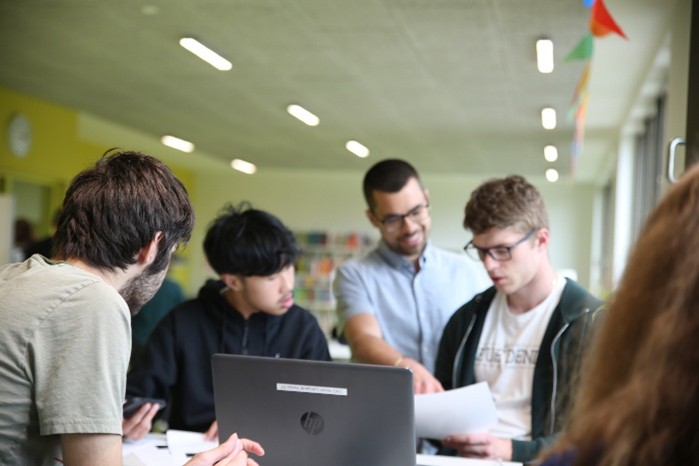
Profile of the Working Group
Research Focus
It is well established that seismicity can be induced during the development and operation of geothermal reservoirs. Microseismic events provide a unique observational basis for characterizing key properties of the reservoir, including fracture systems, fault zones, and reservoir dynamics. Seismic events may also represent a potential risk that can eventually influence the perception of geothermal technologies. A comprehensive understanding of the links between the local stress field, the geomechanical properties of fractures and faults, and the resulting seismicity is therefore essential for the sustainable use of geothermal energy.
Our research addresses the development of advanced seismic monitoring concepts and methodologies with the objective to improve the observation and understanding of seismic processes associated with geothermal operations and subsurface utilization. In parallel, our research integrates societal perspectives to improve the assessment and understanding of the broader implications of induced seismicity. Our work combines observational seismology, innovative sensing technologies and signal processing, as well as interdisciplinary approaches, positioned at the interface between research in Induced Seismicity and Geomechanics and the Social Aspects of Geothermal Energy.
Emerging Sensing Technologies for Seismic Monitoring
A key research direction is the evaluation and comparison of innovative and established instrumentation for seismic monitoring. This includes:
- Plug-and-play, accessible seismic sensors.
- Fiber optic sensing, notably Distributed Acoustic Sensing (DAS), turning fiber optic cables into large-scale distributed sensing arrays.
We investigate how they can complement or transform conventional monitoring approaches, notably in terms of spatial resolution and operational scalability. The thematic focal points are:
- Participatory monitoring for dense monitoring deployments while fostering public involvement and integrating societal perspectives into geo-energy research.
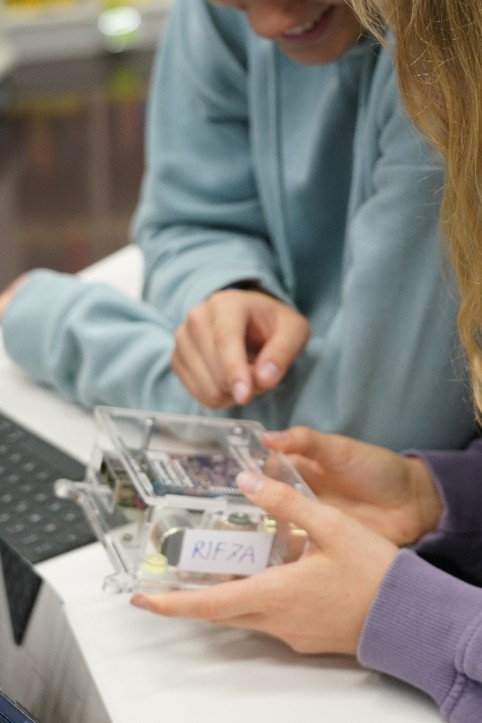
- Use of accessible seismic sensors for educational and outreach activities, integrating seismic measurements into school projects and teaching formats.
- Fiber-optic sensing for dense spatial sampling over distances ranging from hundreds of meters to hundreds of kilometers, including both dedicated installations designed for geophysical monitoring and the reuse of existing telecommunication infrastructure.
From a methodological perspective, our work focuses on the development and application of advanced approaches for
- Data acquisition, instrument characterization, and calibration,
- Signal processing of large-N seismic arrays and dense monitoring networks,
- Data-driven and machine learning–based methods for the detection and extraction of weak seismic signals in noisy environments,
- Systematic evaluation and comparison of innovative and conventional seismic instrumentation, addressing fundamental questions related to their sensitivity and their suitability for monitoring applications.
Projects and activities
INSIDE – Induced Seismicity in the South German Molasse
INSIDE investigates induced seismicity as interacting processes associated with the operation of geothermal plants in the South German Molasse Basin. A central focus lies in the comparison and evaluation of different monitoring technologies, including conventional seismic instrumentation and fiber-optic sensing systems deployed in controlled configurations specifically designed for geophysical monitoring.
RUBADO – DAS on Dark Fiber for Geo-Energy Applications
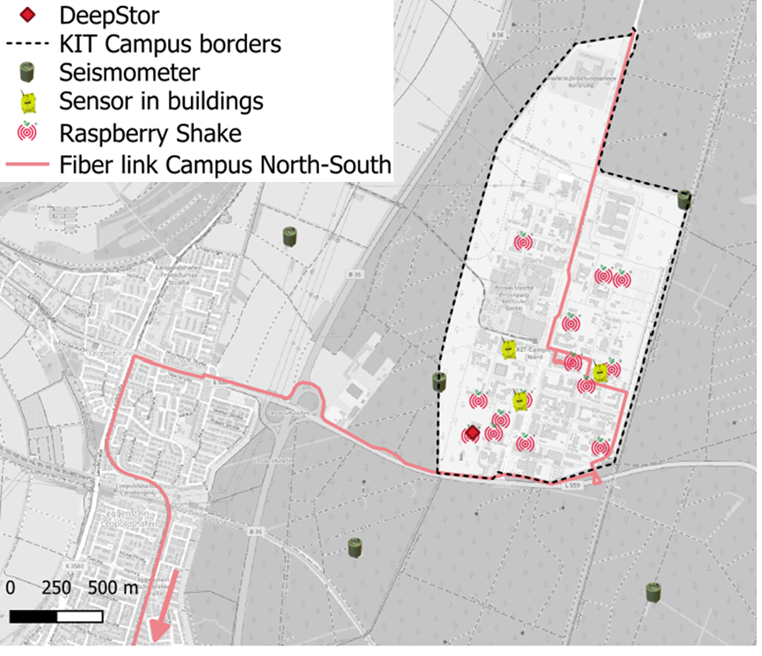
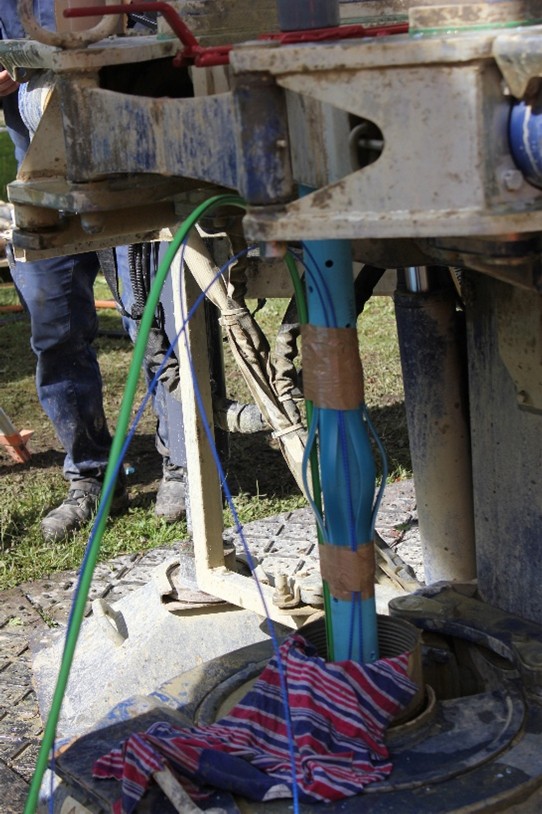
We develop and apply novel approaches for seismic monitoring and subsurface imaging, in particular Distributed Acoustic Sensing (DAS) on dark fiber, leveraging already installed but under-utilized fiber networks. Using these fiber networks, RUBADO investigates the potential of large-aperture, densely sampled sensing arrays for continuous, high-resolution observations over distances reaching up to 100 km along the Upper Rhine Graben. The project aims to improve the monitoring of geothermal reservoir processes and assess the performance and complementarity of DAS relative to conventional seismic instrumentation. Beyond passive acquisitions, the project investigates the use of drilling-induced vibrations as controlled seismic sources for subsurface imaging in the frame of the DeepStor research infrastructure.
Participatory Seismic Monitoring in GeoLaB and DeepStor
In the context of the large-scale research infrastructures GeoLaB and DeepStor, we develop advanced seismic monitoring approaches that incorporate participatory monitoring. Within this framework, interested residents host plug-and-play seismometers that are integrated into existing monitoring networks, enabling participants to engage directly in monitoring activities.
Research infrastructures are not only scientific platforms, but also as spaces for exchange between researchers, stakeholders, and the broader public. Our activities therefore include communication formats that combine information, dialogue and interactive learning approaches.
School and Educational Projects at IGS Wörth and Heisenberg-Gymnasium Bruchsal
With school projects, we organise research-oriented educational activities to communicate on geosciences and the broader context of geo-energy systems. We integrate real seismic data and measurement technologies into short educational programs that provides insight into scientific research practices and supports engagement with topics related to seismology, geothermal energy, and the energy transition.
| Name | Kontakt | Tel. |
|---|---|---|
| Azzola, Jerome Akademischer Mitarbeiter – PostDoc |
+49 721 608-45289 jerome azzola ∂does-not-exist.kit edu CS 50.40 247 |
+49 721 608-45289 |
| Esmaeilikhansari, Ghazaleh |
+49 721 608-45223 CS 50.40 248 |
+49 721 608-45223 |
| Gaucher, Emmanuel Academic Researcher - Geophysicist |
+49 721 608-45223 emmanuel gaucher ∂does-not-exist.kit edu CS 50.40 248 |
+49 721 608-45223 |

Akademischer Mitarbeiter – PostDoc
 +49 721 608-45289
 jerome azzola ∂does-not-exist.kit edu
 247
247 50.40 Campus Süd