
Excursions
Iceland Field Excursion 2025
Experiencing Geothermal Energy and Volcanism Up Close
In August 2025, a group of students and lecturers from the Institute of Applied Geosciences (AGW) at the Karlsruhe Institute of Technology (KIT) participated in a geoscientific field excursion to Iceland. The objective of the trip was to investigate one of the world's most active geothermal regions on site and to experience theoretical concepts related to volcanism and deep geothermal systems directly in the field and at operating facilities. Iceland offers optimal conditions for this purpose, as no other location on Earth allows for direct and comprehensive observation of plate tectonics, volcanism, hydrothermal processes, and their technological utilization for energy production.
Iceland – Interface Between Geodynamics and the Energy Transition
Iceland is located on the Mid-Atlantic Ridge and represents the only large subaerial landmass rising above this oceanic spreading center. At this location, the North American and Eurasian plates diverge while mantle material is continuously supplied to the surface. This process is accompanied by intense volcanic activity. The region is also influenced by a deep-rooted mantle plume, which contributes to elevated magma fluxes. This geodynamic configuration makes Iceland a global hotspot for geothermal energy, both from a geological and an energy-economic perspective.
From the outset of the excursion, it became evident that geothermal energy utilization in Iceland is a significant and well-established component of the national energy system. It is estimated that approximately 90% of households utilize geothermal energy for heating, and a significant portion of electricity is derived from geothermal power plants. Consequently, participants were able to explore sustainable energy production from both theoretical and practical, large-scale operational perspectives.
The excursion's initial stop was the Reykjanes Peninsula, located in southwestern Iceland. The region is located directly at an active plate boundary and is characterized by fissure systems, young lava fields, and geothermal manifestations such as hot springs, solfataras, and hydrogen sulfide emissions. The elevated tectonic activity has been shown to result in enhanced subsurface permeability, thereby creating favorable conditions for the development of geothermal systems.
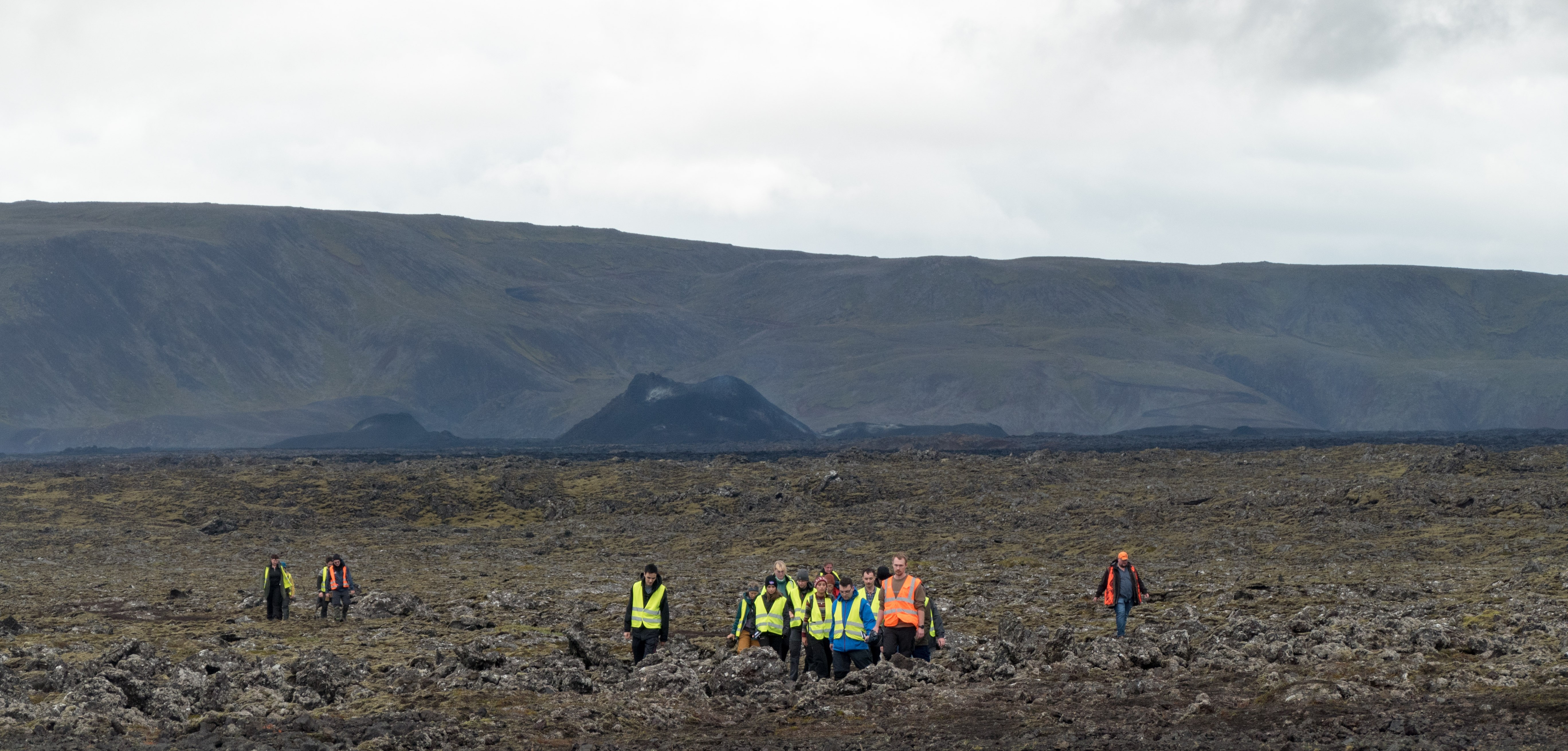
On site, the relationships between extensional tectonics, dyke intrusions, and heat transport were discussed. A central focus was the visit to the Svartsengi geothermal power plant, where high-enthalpy fluids and steam are extracted from depth while fresh lava flows occur only a few hundred meters away. The close spatial relationship between natural processes and technological utilization became clearly visible. Another stop included a visit to the abandoned town of Grindavík, which was evacuated due to ongoing volcanic activity, highlighting the dynamic nature of the region (Fig. 1).
A further example was the Hellisheiði geothermal power plant in the Hengill volcanic area. Here, high-temperature geothermal resources are used for both electricity generation and district heating. With a capacity of approximately 130 MWth and 300 MWe, the facility supplies a significant portion of the capital region. The Hengill volcanic system itself was also traversed, providing insights into the geological framework that supports the Hellisheiði and Nesjavellir power plants (Fig. 2). Numerous smaller geothermal areas displaying vivid alteration colors were observed during field walks (Fig. 3).
During visits to geothermal facilities, participants received insights into drilling technology, production strategies, reinjection concepts, and long-term reservoir management. The Carbfix project represents an innovative approach to carbon dioxide reduction. In this process, CO₂ dissolved in water is injected into basaltic formations, where it becomes mineralized within relatively short geological timeframes. Iceland’s young and reactive basalts provide ideal conditions for this technology. The excursion demonstrated that geothermal energy can contribute to climate mitigation beyond energy production alone, as the integration of geothermal infrastructure and CO₂ sequestration opens new pathways toward carbon-neutral energy systems.
Iceland is often referred to as the “land of ice and fire”. The interaction between volcanism and glaciation produces unique landscapes and natural phenomena, such as the Vatnajökull ice cap, the largest glacier in Europe (Fig. 4). Much of Iceland’s rock mass consists of hyaloclastites formed through magma-water or magma-ice interactions. Observations of retreating glacier tongues also illustrated ongoing climate change impacts. At Diamond Beach, glacier fragments drift from the glacial lagoon into the North Atlantic Ocean and are washed ashore, where they reflect sunlight against the black volcanic sand (Fig. 5).
A field excursion into the Icelandic highlands led past the iconic mountain Herðubreið to the Askja volcanic system. Askja is an active central volcano north of Vatnajökull containing two crater lakes and forming part of the Dyngjufjöll massif (Fig. 6). Under conditions of persistent rain, fog, and strong winds, the group traversed the crater to the shoreline of the smaller lake, turning the excursion into a challenging field experience.
In northeastern Iceland, the group observed geological structures that document different phases of magmatic evolution. Near Vestrahorn, erosion exposes a solidified magma chamber, providing insight into subsurface magmatic processes. Further north, dyke swarms cutting through overlying lava sequences were examined along fjord flanks. These features contribute to Iceland’s geothermal potential, although the geological events responsible for them are separated by hundreds of thousands of years.
At the black sand beach near Vík í Mýrdal, extensive basalt column formations were studied (Fig. 7). These structures formed through slow cooling of magma within the crust. Thermal contraction created characteristic hexagonal jointing, with columns growing perpendicular to cooling surfaces. Puffin populations inhabit these cliffs and remain largely unaffected by human presence.
In northern Iceland, the Krafla geothermal field was visited. The system is located within the caldera of a central volcano and represents a typical high-temperature geothermal field. Discussions focused on rift-related “fire episodes,” periods of intensified volcanic and tectonic activity characterized by earthquakes, magma intrusions, and surface deformation (Fig. 8). These processes significantly influence geothermal reservoir conditions.
Key questions of deep geothermal research were addressed, including the effects of magma ascent on subsurface permeability, the role of fractures and faults in fluid circulation, and the safe and sustainable utilization of dynamic geothermal systems.
Throughout the excursion, interactions between geothermal fluids and host rocks were a recurring theme (Fig. 9). At Krafla, participants observed a fully altered volcanic edifice exhibiting hot springs, mud pools, gas emissions, and natural sulfur deposits. Alteration minerals such as zeolites, epidote, and chlorite provide information on temperature conditions, fluid chemistry, and residence times. These processes are not only of geological interest but also have technical implications, including scaling and corrosion.
Participants were introduced to geochemical methods used to estimate reservoir temperatures (geothermometers) and to trace element and isotope analyses applied in geothermal system characterization. Such methods are highly relevant for deep geothermal projects in Germany and across Europe.
Iceland represents a compelling example of the potential of geothermal energy when geological understanding, technical expertise, and long-term resource management are combined. The August 2025 excursion illustrated these relationships and highlighted the role geothermal energy can play in future sustainable energy systems. For the AGW, Iceland serves not only as an excursion destination but also as a reference environment for research, education, and the development of sustainable technologies (Fig. 10).


